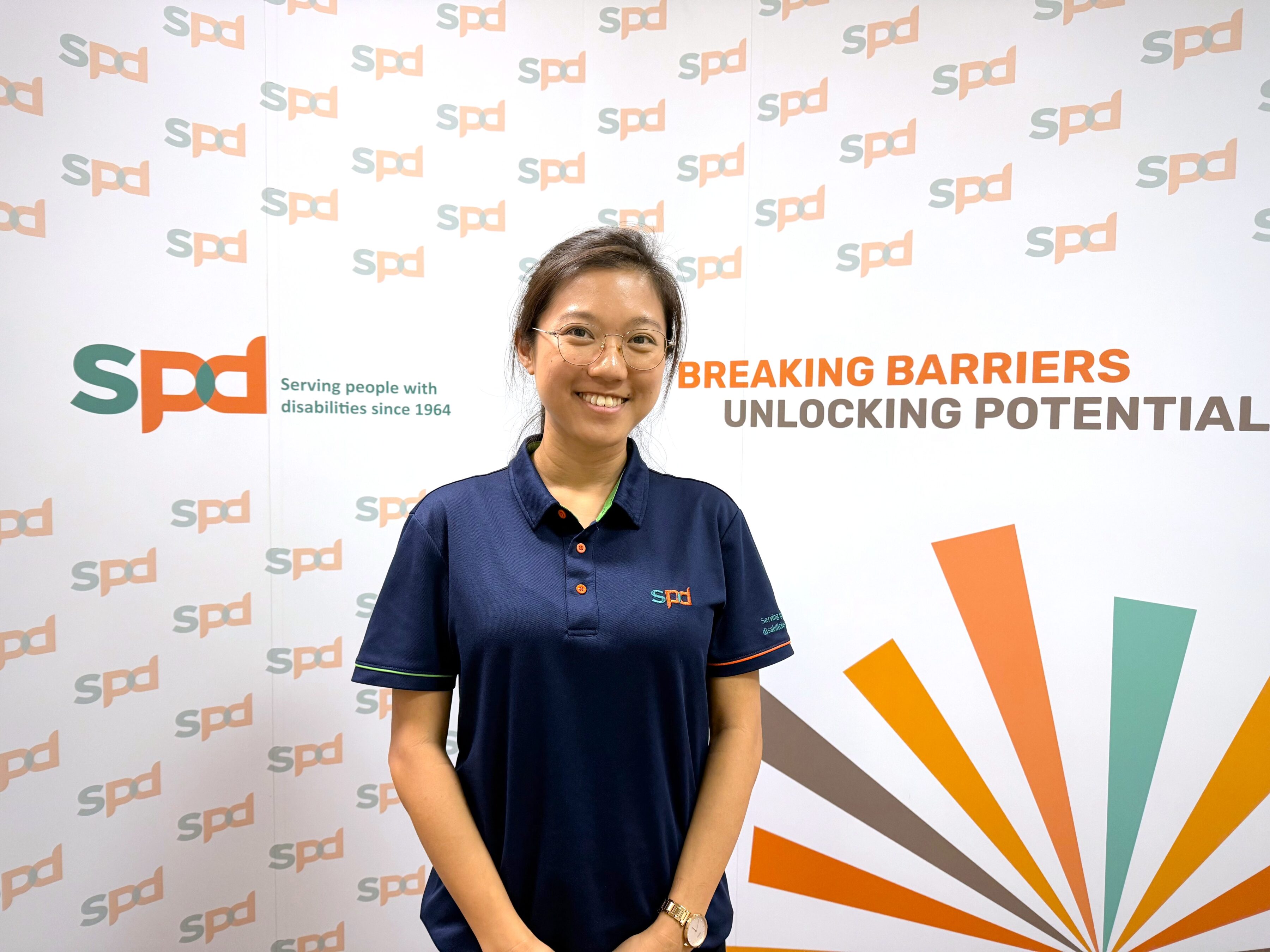
In this Power of Care feature, meet Chua Jia Yi, SPD’s senior speech therapist who helps children find their voices. Whether she is in a lively pre-school classroom or guiding caregivers to turn daily routines into learning opportunities, she sees every interaction as a chance to spark connection. For Jia Yi, she wants to help every child she supports, be seen, heard and understood.
UPDATES: Tell us more about your role as a senior speech therapist.
Jia Yi: No two days are the same for me as I move between pre-schools and centre-based programmes to support children aged six and below.
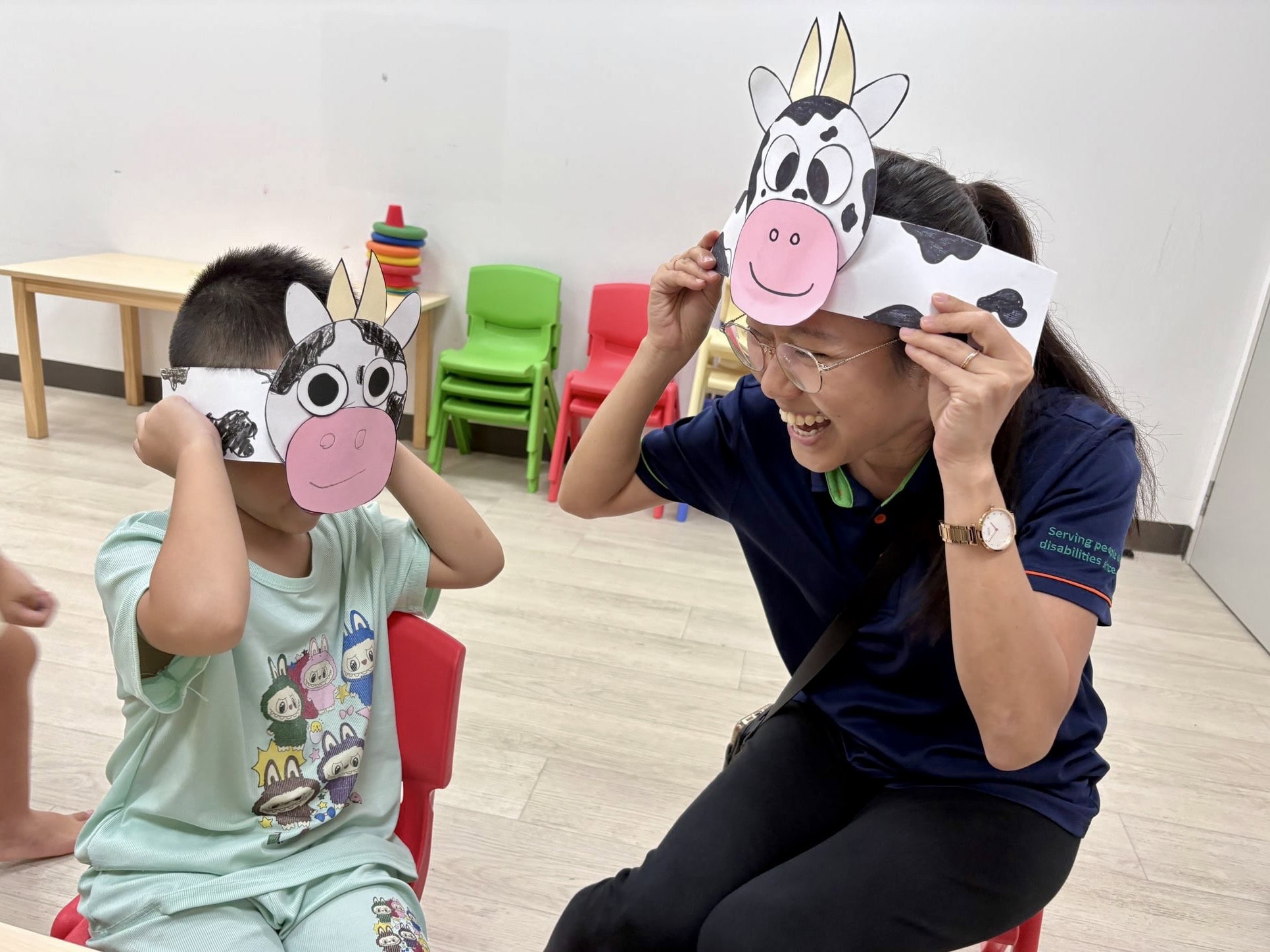
During art and craft, Jia Yi joins in a child to playfully pretend to be cows after making the headbands.
Some days begin at a pre-school where I provide intervention under the DS plus programme. In class, I join Client M, a bubbly 6-year-old boy, as he chats with his peers about his weekend. We practise speech sounds in conversations and blend simple words from story books to strengthen his reading. After each session, I jot down updates for home practice and share strategies with his teacher so she can reinforce them in class. What I like about being a roaming therapist is seeing how intervention fits into our clients’ daily routines.
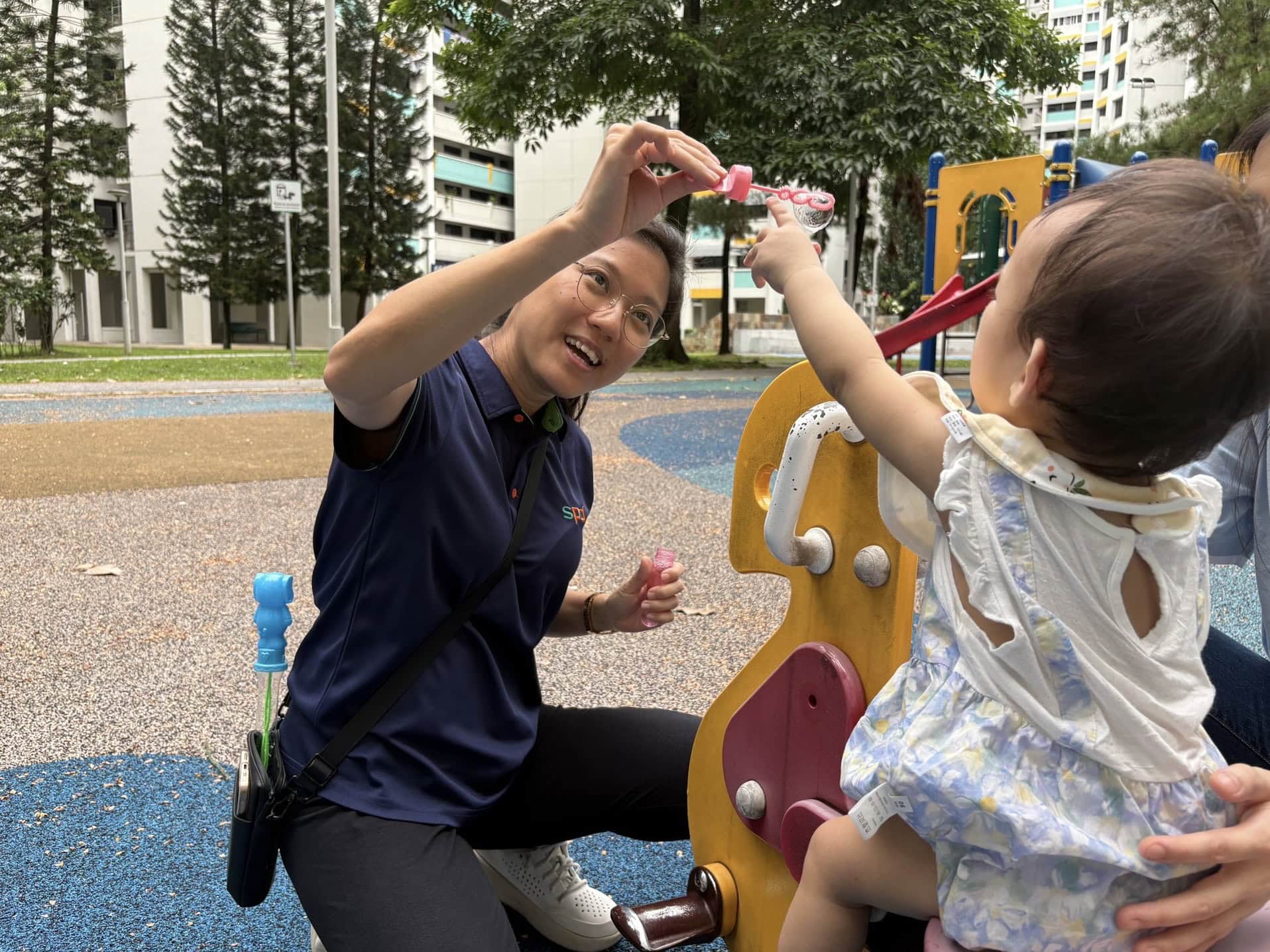
Jia Yi engaging with a child from our EIPIC Under-2 programme during outdoor play.
On another day, I’m based at one of SPD’s EIPIC centres, providing intervention as part of the Under 2s programme. I join the teachers, children and caregivers in routines such as story time, sensory play, outdoor time and snack time, showing caregivers how they can carry out strategies at home. What I enjoy most is hearing caregivers share what they’ve tried at home and celebrating the children’s progress.
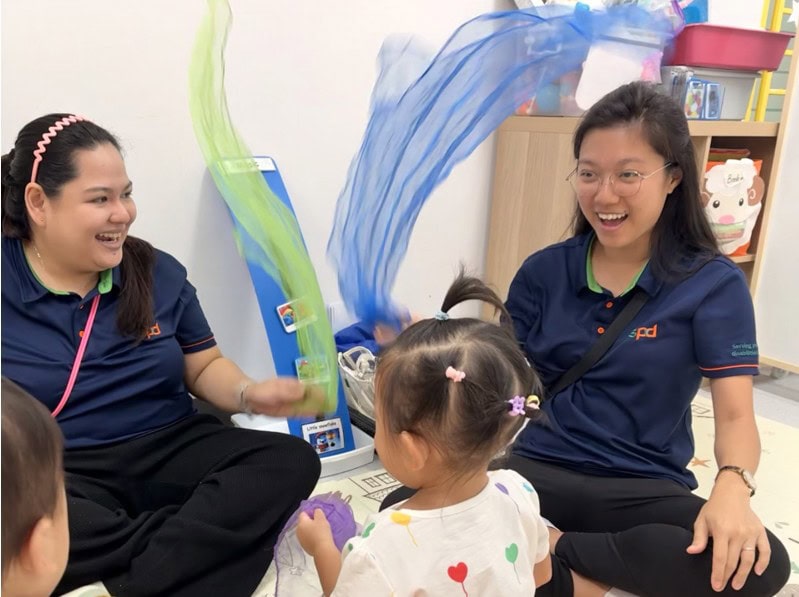
Jia Yi singing “Jiggle your scarf” along with the children and their teacher during music and movement session.
UPDATES: Besides clinical duties, what other responsibilities or roles do you take on?
Jia Yi: I also set aside time to supervise junior speech therapists. We discuss cases and support one another in our practice, something I find vital in sustaining quality care. Beyond that, I work with our management on staff development and serve on an internal resource team to help professionals apply consistent service standards.
More recently, I’ve begun exploring my interest in educating future speech therapists, occasionally lecturing to share my ground experience.
UPDATES: What inspired you to become a speech therapist?
Jia Yi: A culmination of experiences had led me to this profession. One of the first was during my university days, when I volunteered at a welfare services club and befriended individuals with hearing loss. I had just learnt basic sign language, and it was challenging to express myself with only a few signs. It got me thinking how isolating it can be when you struggle to communicate or are not understood.
Later, while tutoring children with hearing loss, I found myself wanting to help them pronounce words clearly. I also wondered how to explain the concepts better as I was not fluent in sign language then – which resulted in me using ways like drawing or gesturing. Looking back, I’m glad to have chosen this path as a speech therapist, as I now have the skills to help these children.
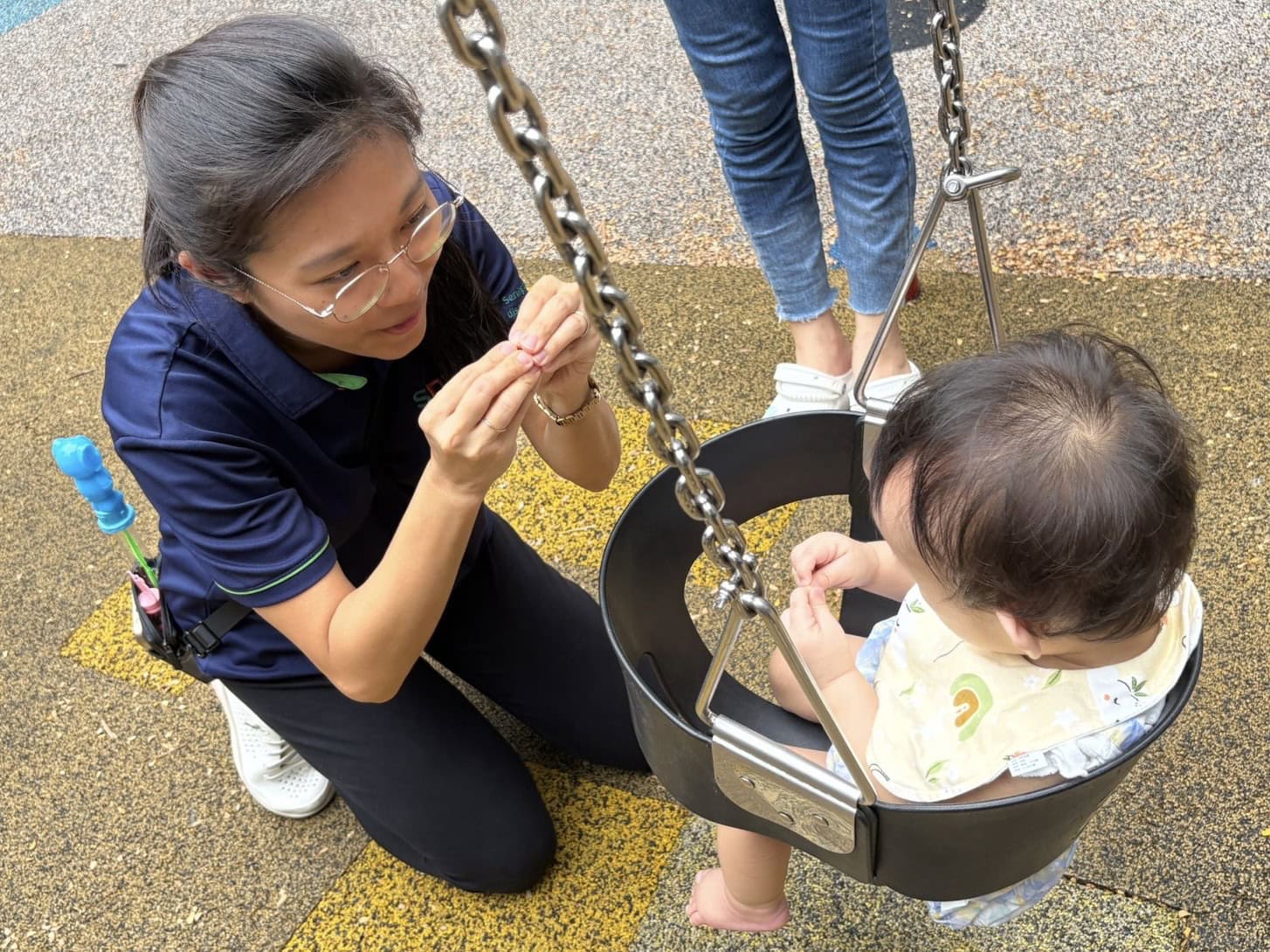
During outdoor play, Jia Yi guides a child in using the sign “more” to indicate her want to continue swinging.
UPDATES: What are some challenges you face in your work and how have they shaped the way you approach care?
Jia Yi: Every family has different levels of understanding and acceptance of their child’s needs. There are moments that I wished I had all the answers, but I’ve learnt that what families need most is often empathy.
I remember there was a child new to our early intervention programme. His mother had dutifully tried the strategies that we shared with her, but as the sole caregiver, she was exhausted. Her child’s frequent meltdowns also took a toll on her physically and mentally. When our social worker stepped in, I was reminded that as much as we want to help the child, we need to be mindful of what the caregiver can manage. Subsequently, we encouraged her to engage in self-care, helped identify her support system and focused on key strategies at a manageable pace. Through this experience, I have learnt that supporting the caregiver’s wellbeing is imperative for the child to receive quality care.
UPDATES: Can you share a time when strong collaboration with colleagues, caregivers, or other partners made a difference in your work?
Jia Yi: We once supported a toddler with Down’s syndrome and moderate hearing loss as we explored suitable communication options such as gestures, signs, pictures, or speech. After discussing with his mother, we introduced pictures and were pleasantly surprised when he reached for the picture of the snack he wanted! From there, we decided as a team to use the Picture Exchange Communication System (PECS), while introducing some key signs.
We started practising in the centre with his parents, teaching him to request for his favourites like ‘bubbles’ and ‘biscuit’. Soon, his parents built on it at home, encouraging him to communicate with other family members too. This helped the child use his skills across different people and environments. This reminded me that meaningful progress happens when professionals and caregivers work together toward the same goal to see.
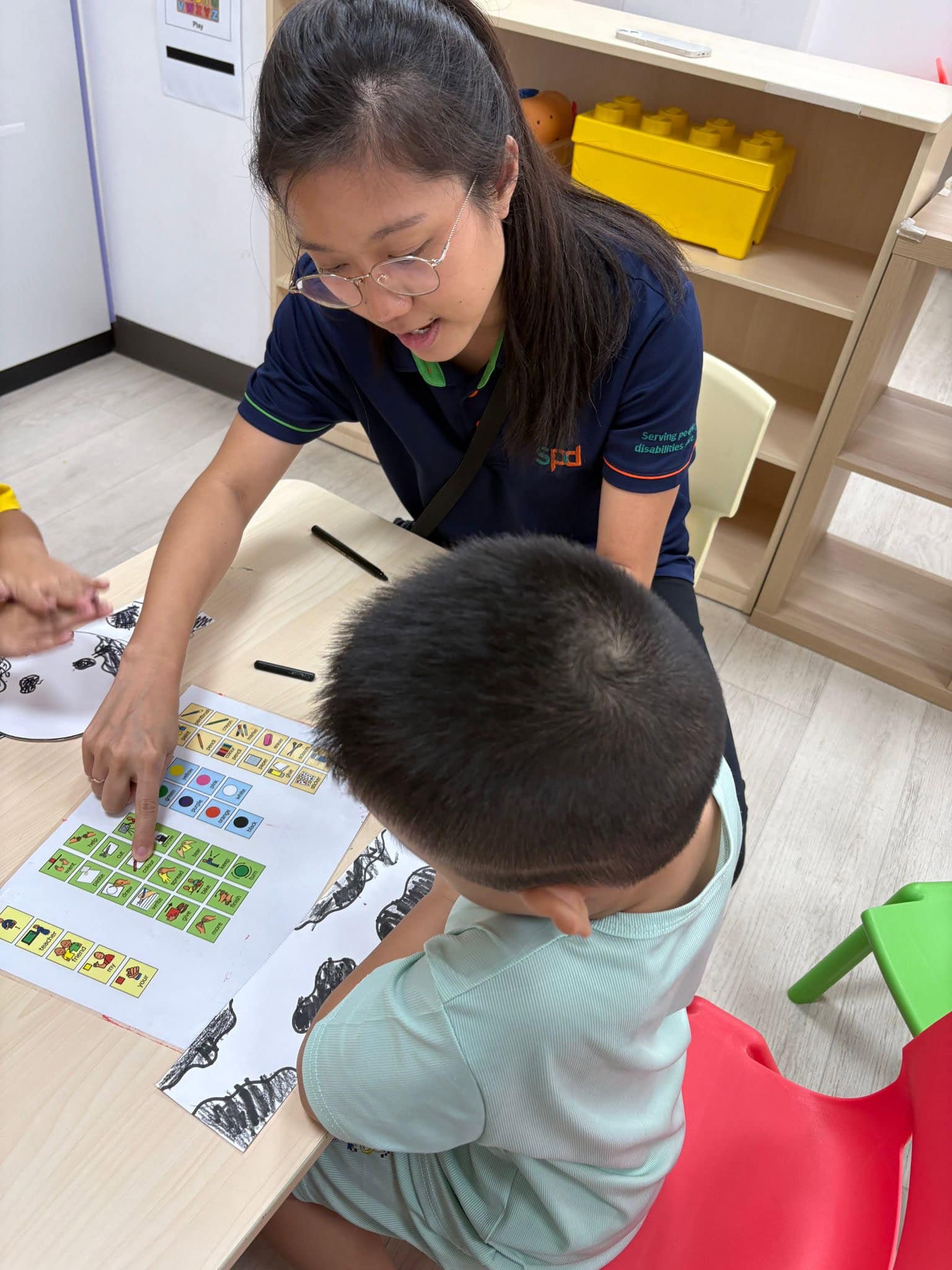
Jia Yi showing a child how to form short phrases with an Augmentative and Alternative Communication (AAC) to express his thoughts.
UPDATES: How do you define care? How do you bring that to life in your work?
Jia Yi: To me, ‘care’ is about meeting people where they are – understanding their current needs, emotional state and readiness to change. Only then can we provide the support that they need.
As a speech therapist, I often ask my older clients or parents of younger clients what they hope to achieve so that I can tailor the intervention to work towards our shared goals.
As a clinical supervisor, I start with the same curiosity, inviting students or supervisees to share how they are and what they want to learn. I’ve found that learning is most effective when it is intrinsically motivated.
Over the years, I’ve also learnt to ask those questions of myself. Checking in, reflecting and taking time to recharge, because caring for myself allows me to better care for others.
UPDATES: Can you share a memorable moment that reminded you why you chose to be a speech therapist?
Jia Yi: While some parents wish their child would talk less, others long for the day their child calls them ‘papa’ or ‘mama’. I remember one parent sharing that her biggest hope was for her child to call her ‘mama’. These words carried such deep longing that I could feel it too.
By the time he graduated from our programme, he could verbalise short phrases and express himself using a communication app.
I also remember parents tearing up the first time they see their child use a picture to make a request independently. And the joy we all felt – parents, teachers and I – when we hear a child imitating a word after weeks of modelling. Moments like these stay with me and remind me why I became a speech therapist.
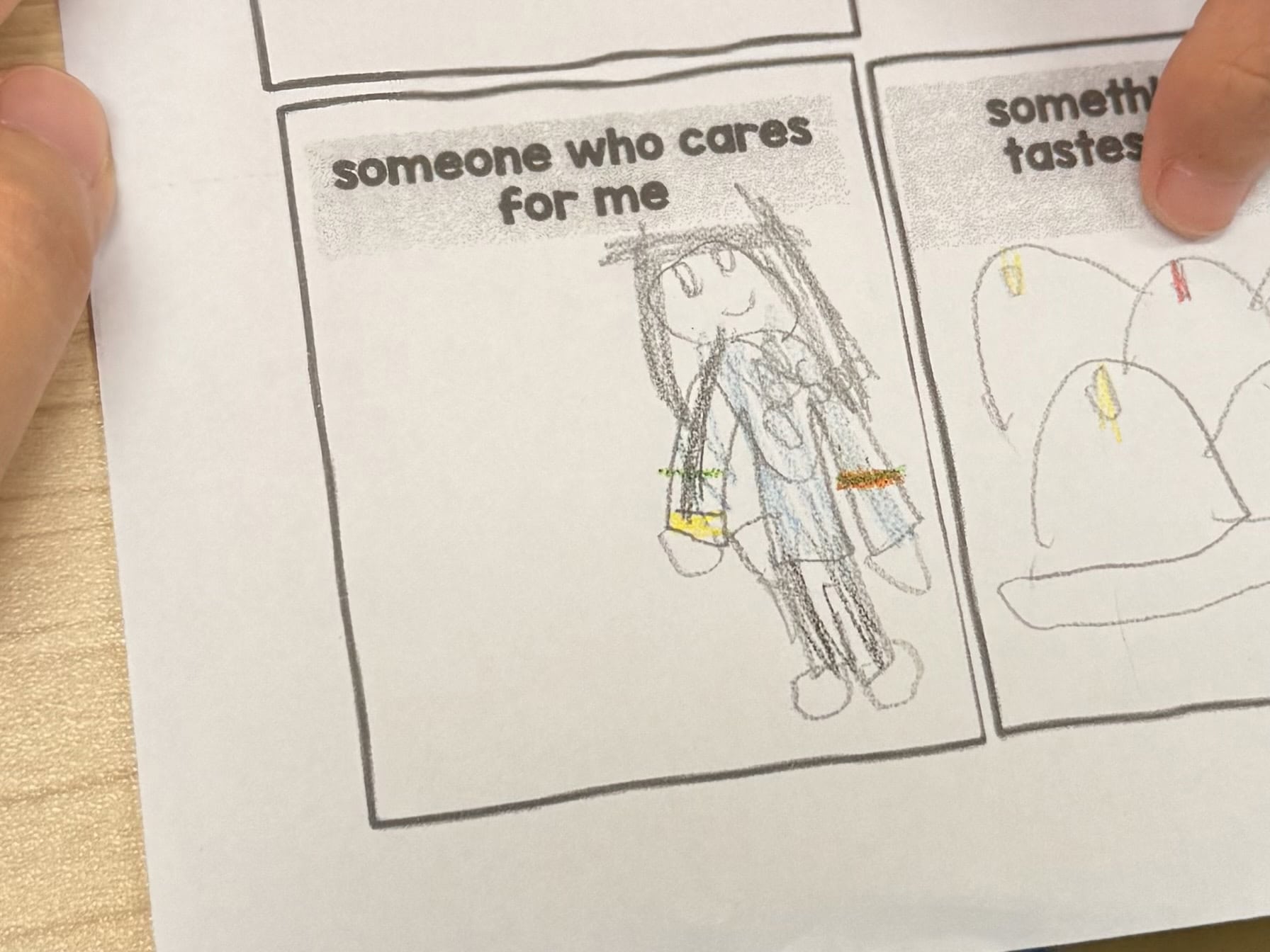
A drawing of Jia Yi by a child in response to a worksheet prompt “Someone who cares for me” during work time.
UPDATES: What’s something interesting or unexpected about being a speech therapist that people might not know?
Jia Yi: A speech therapist does not only work on pronunciation or help people learn to speak. We work on a range of areas such as language, social communication, feeding, swallowing, voice and fluency. Beyond all that, my hope is to help individuals find their voice – because everyone deserves to be heard, understood and valued.