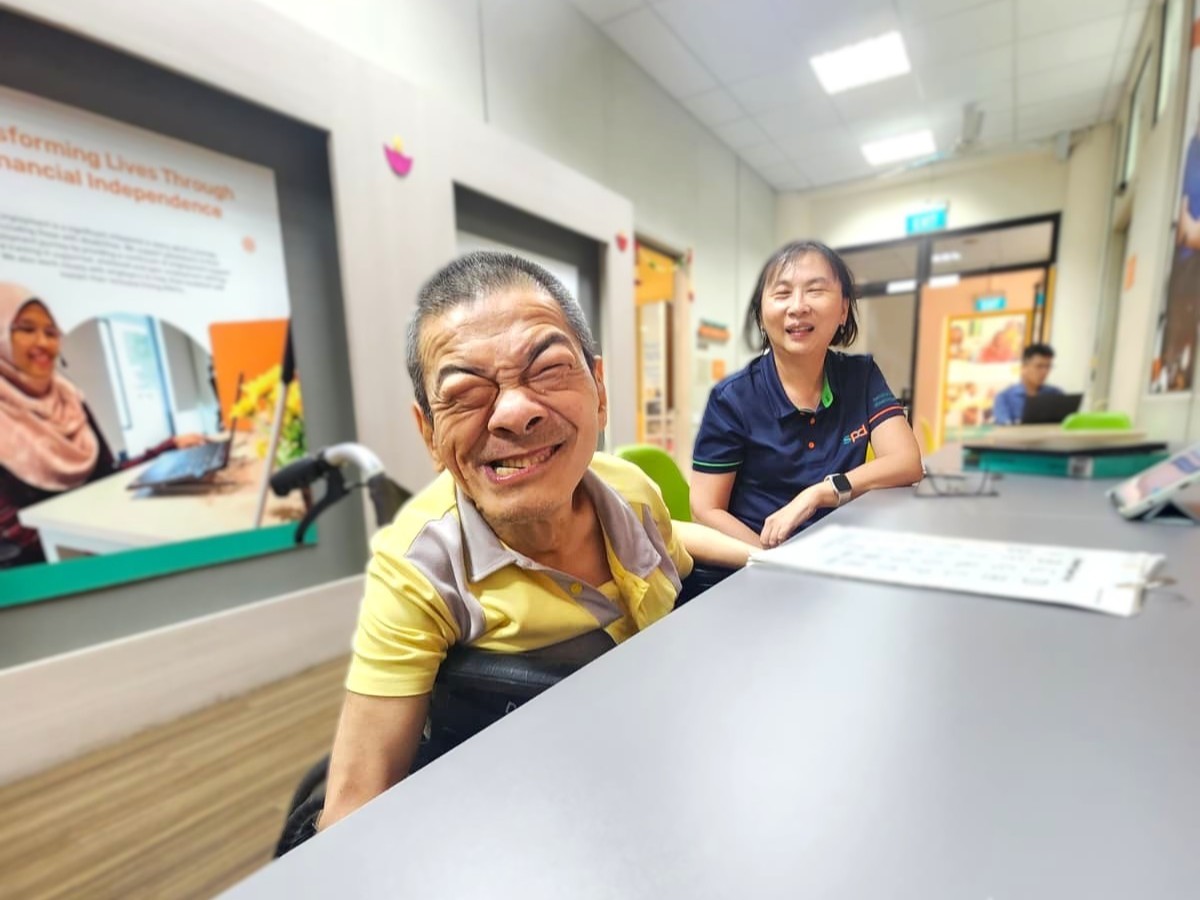
Language is far more than asking for a snack or choosing an activity. It is how we connect with others, share our emotions and express our individuality. Speech therapists help persons with speech impairment retrain and strengthen the physical, neurological and cognitive systems involved in communication. Yet therapy often centres on everyday requests, leaving little room for personal expression.
Sarah Yong, principal speech therapist at SPD’s Specialised Assistive Technology Centre, shares how she uses poetry as a creative augmentative and alternative communication (AAC) intervention to support the self-expression of Mr James Poh, who has cerebral palsy and is a client of SPD’s Enabling Skills for Life Programme (ESLP) – Living Skills. Her approach reflects SPD’s expertise: our therapists go beyond teaching clients to use communication tools, and help them find their own voice and the words to share what matters to them.
Breaking the conventions to find a voice
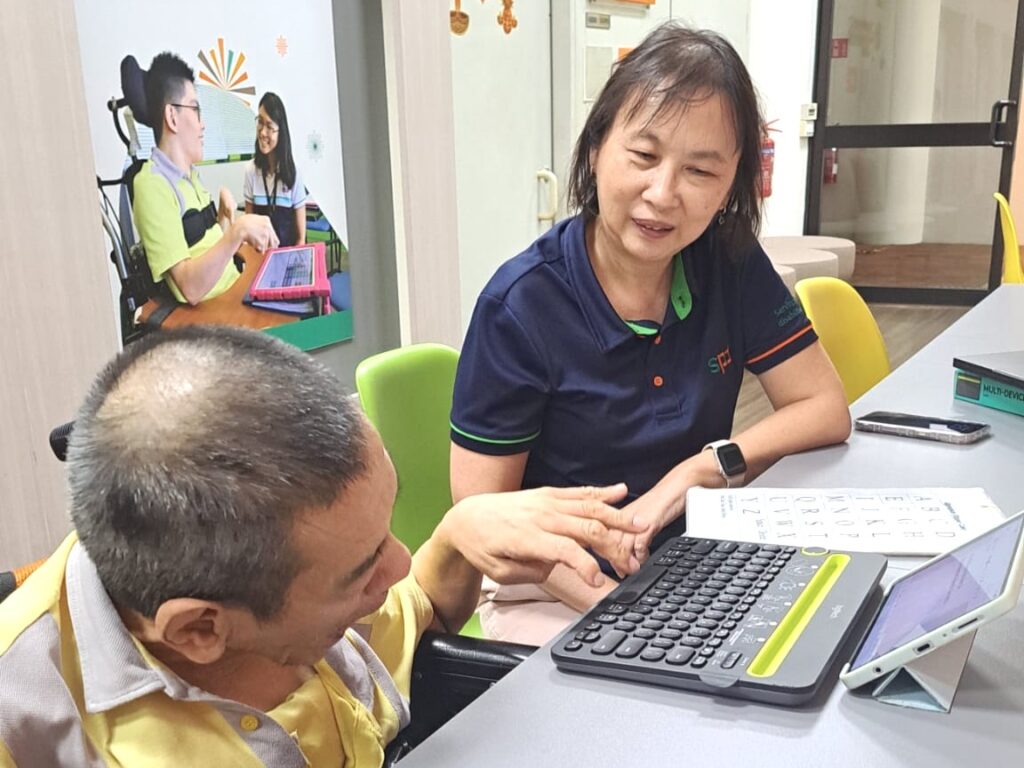
AAC covers the tools and strategies, from alphabet and picture boards to speech-generating devices, that support individuals with severe speech difficulties or who cannot speak. Yet conventional language favours full sentences, strict grammar and fast-paced conversations, which are hard when every word takes effort.
Poetry, by design, breaks these rules. Fragmented lines, single-word verses and unconventional word pairings are celebrated, giving AAC users the freedom to experiment without fear of being “corrected”. Poetry thus becomes a low-pressure, highly expressive medium for exploring vocabulary and rhythm while building language skills for everyday conversations.
Mr Poh’s journey: from basic needs to rich storytelling
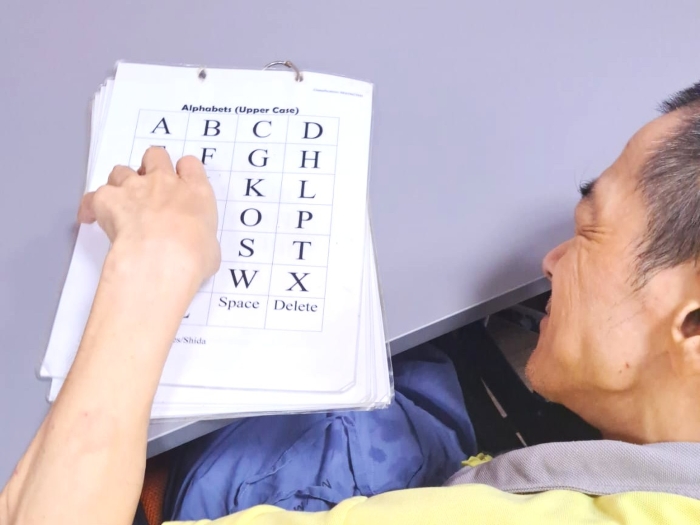
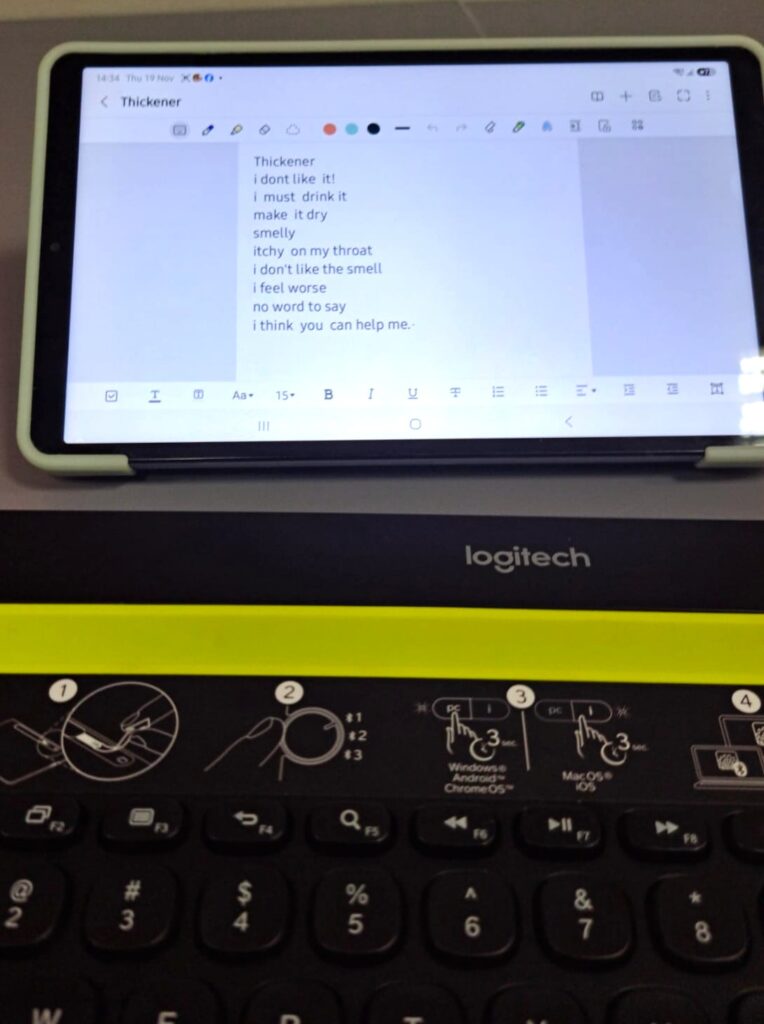
An alphabet board and a tablet were Mr Poh’s main tools for communicating with the world. Sarah observed that Mr Poh had difficulty isolating individual keys on a standard keyboard, and his reduced finger dexterity caused him to press the same key repeatedly. The team introduced an alternative keyboard and some accessibility functions, which reduced typing errors and improved the accuracy and fluency of his written work.
Mr Poh could use simple sentences, but mostly to express basic needs. What he needed was a reason, and the space, to say more.
To broaden his scope, Sarah introduced “List Poems”, a format in which he lists items alongside descriptive details. Together, they also read works by other poets, which improved his reading comprehension and gave him new vocabulary to draw on.
Within two months, Mr Poh progressed from listing isolated nouns to using a rich mix of verbs, adjectives and varied sentence structures. During this period, he was hospitalised and placed on thickened fluids due to swallowing difficulties. Unlike previous occasions when he could not express his frustration, he used poetry to say that he disliked the modified fluids:
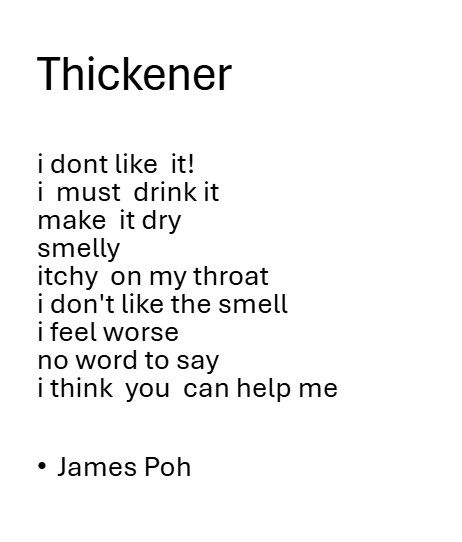
AAC was no longer just a way to request; it had become a way to advocate for himself.
Reclaiming autonomy and identity
Individuals who use AAC often face barriers to verbal communication and are rarely asked for their opinions. Over time, this can erode their confidence and leave them passive or unaccustomed to asserting their views.
Poetry flips this dynamic. Traditional exercises rely on questions such as “what colour do you want” or “Tell me what you did today”. Open-ended poetic prompts such as balloons or a favourite person, by contrast, offer a blank canvas. Mr Poh chose topics that interested him, such as sports, underwater creatures and family. When Sarah asked why he liked writing poems, Mr Poh said, through his AAC, that it is “wonderful” and that “people now know how he feels”. Seeing how much progress he has made, Sarah would like to continue using poetry to expand his writing, trying different types of poems and widening his range of topics and vocabulary.
Poetry shifts the focus from operating a device to exploring who a person truly is. This is the heart of SPD’s approach: pairing clinical knowledge with creativity to look beyond functional needs to the person behind the screen. For Mr Poh and many others, poetry becomes a bridge to intentional conversations, meaningful connections and a voice that is unmistakably their own